The Halls of Learning Have Become Temples of Inversion
I saw through the communist indoctrination in college back in the ’90s. It made me sick. I dropped out and got a job as a cocktail waitress at Harvey’s Lake Tahoe.
I went on to work many odd jobs singing, waiting tables, selling timeshare, selling other products, but I never settled on a career path. Nothing felt right.
I’ve watched ever since as that indoctrination machine only got more powerful, more invasive, more demonic.
Most young people then and now have been surrounded by well-meaning voices of family, friends, and mentors who subtly (or not so subtly) pressure them to prove their worth by going down the path of “higher education.”
But let’s be honest: Most of us can’t afford to send our children to the rare Christian or conservative colleges that still stand. And even those aren’t perfect.
The pressure to conform, to bow before the cult of the radical left, the one that controls almost every university and public institution, is suffocating. The options so few and frankly either intimidating and out of reach for most people – or demeaning, uninspiring, and miserably unpleasant.
And it is not neutral.
It is not kind.
It is not tolerant.
It is demonic. Full stop.
This is the upside-down spirit of the age: A loveless, cruel, anti-human, eugenic and sickly secular ideology that wants to tear our children from truth, from beauty, from natural law, and from God Himself.
If you don’t believe in God yet, fine. But you’d have to be blind not to see that something truly evil is loose in the world.
Something that hates the good.
Something that mocks and murders innocence.
Something that calls what is pure “hateful” and what is perverse “liberating.”
I believe it’s demons.
You may not believe in them, but they believe in you. They know how to invisibly influence you and harm you through your desires, your thoughts and emotions. Your vices. Your sins.
This is a spiritual war for your soul, and if you can’t see that yet, I beg you:
Open your soul.
Stop scrolling.
Get silent.
PRAY.
Because the Spiritual War is real, and our children’s souls are on the front lines, and ours are too.
There’s a strange trick that modern culture has played on us as women. In the name of “empowerment,” we’re told to prove ourselves in masculine arenas; in competition, in the workforce, in the constant hustle, in the ring of performance and production.
We may not even call ourselves feminists, yet the culture has trained us to be in a feminist mindset as our default: so much in our masculine energy that we feel anxious when we are in our feminine – a nagging feeling that we must strive to keep up with, or even outdo men.
How sad is this?
The truth many of us don’t want to admit ourselves? Most women’s nervous systems simply weren’t designed and are not capable of thriving and being healthy in that constant, masculine fight mindset. Hunter mindset. WARRIOR mindset.This doesn’t feel natural to most women, on any level – emotionally, mentally, spiritually and physically. It doesn’t feel good.
LARPING AS MEN DRAINS MOST WOMEN, AND DRAINED WOMEN ARE MISERABLE WOMEN!
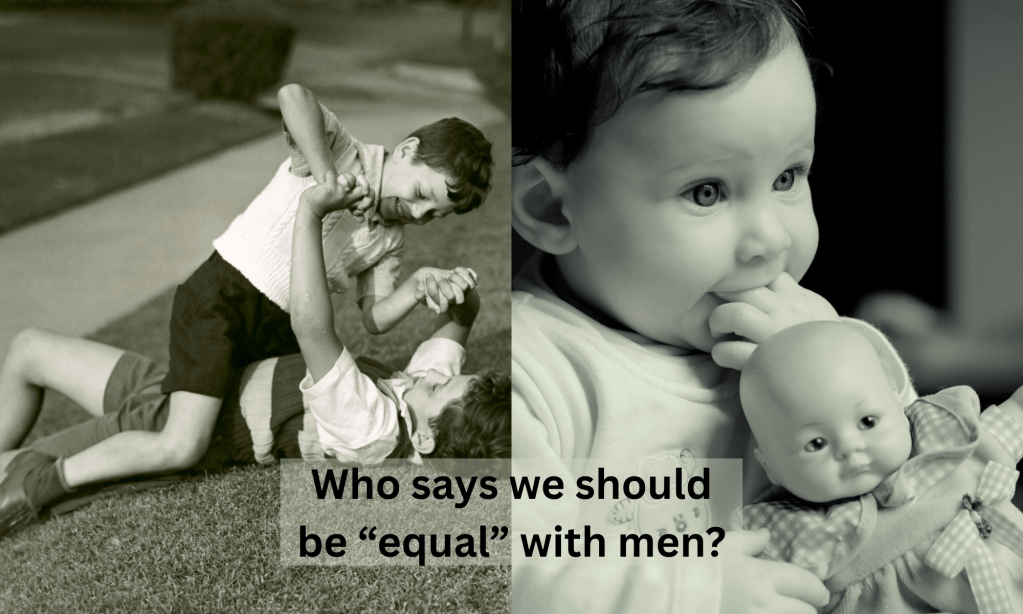
Think back to childhood. Most boys wrestled every chance they got. Girls gravitated toward dolls, soft blankets, stuffed animals, imaginary families and relationships. Even when some of us joined in the roughhousing, it wasn’t usually our deepest joy – we loved nurturing, creating beauty, and being close to the people we loved. Some girls liked to fight boys, but it was from a competitive and masculine space that we did so. A need to feel “equal.”
How sad is this?
And yet, as adults, we’ve been told that true womanhood means competing like men, hustling and fighting like men, climbing ladders like men. We’ve been tricked into believing that to be pro-woman means to reject the very essence of our softness, our receptivity, our tender strength.
But living in that space long-term leaves many of us anxious, bitter, hardened, and weary. Because the truth is: we were made to be soft and gushy creatures. To bring warmth and love into the spaces we touch. To nurture our families, to care for our communities, to fill the world with beauty, gentleness, and soul. That is not weakness. That is power of a completely different kind — the kind the world desperately needs. beauty, gentleness, and soul. That is not weakness. That is power of a completely different kind – the kind this world SO desperately needs in this time.
When we step back into that energy, we often realize that the masculine arenas don’t actually feel comfortable or positive for us. They’re not “bad,” they’re just not ours.
And that’s okay.
The work is not about judging women who find themselves stuck in masculine performance mode- it’s about compassionately asking: Does this actually make me happy? Does this feel like who I am?
I’ve been there. I’ve felt the pull to “prove myself,” to try to live like a man and reject my soft and feminine nature because I thought it was weakness. But the more I soften, the more I allow myself to embrace my God-given femininity, the more alive and joyful I feel.
So what can we do to step back into feminine energy?
Rest without guilt. Your worth isn’t measured by output. Let your nervous system exhale.
Create beauty. Cook, decorate, garden, craft, sing — whatever awakens your soft creative joy.
Nurture. Care for children, pets, friends, or even plants. Pour love into something that thrives under your touch.
Receive. Let yourself be cared for, supported, and cherished by men instead of competing with them.
Sisterhood. Connect with other women who want to live in gentleness and authenticity. Build each other up.
Pray and re-align. Ask God to restore your feminine heart and give you peace in the role He designed for you.
We don’t need to prove ourselves by living like men. We don’t need to LARP as something we’re not. We need only to return to what we already are: beloved, radiant, tender, life-giving women.
Feminism told us we women would be “equal” if we were like men. Equal in the workplace. Equal in ambition. Equal in providing.
So now women are expected to pour out just as much masculine energy as men (gotta be equal, right?) And still come home to cook, clean, mother and be the perfect little wifey with femininity and grace.
But here’s the twist no one wants to admit: Masculine energy doesn’t submit to masculine energy. But most men want their women to bring home the bacon (masculine provider energy required) yet still be soft and submissive. This Is rarely possible and actually leads women to resent their man for expecting that. It doesn’t feel right.
So what happens in a marriage when no one yields? Head-butting!
We’re told men and women are interchangeable but clearly God didn’t design us that way. Sure, some men adapt better than others. They lean more feminine. They can take a back seat and yield equally to their woman. They do their equal part in maintaining the home, or at least try. They don’t demand their working wives larp as stay at home wives at home. As they shouldn’t!
Others – MOST- still want a sweet, nurturing wife who does most of the home stuff but wants a paycheck from her too.
But how can she be both mother and man? It doesn’t FEEL right to most men when their woman has a lot of masculine energy. She gives off controlling mother vibes to them. Because mothers use masculine energy when they discipline and teach their kids. So men grow unattracted to women who give off macho mother vibes.
Most women cant be really gentle and sweet -and focused on and driven to succeed in the world at the same time. How can she be both submissive at home and stressed over money and career at work? It’s ILLOGICAL. Very few women can do this.
And we wonder why the birth rate is plummeting. We’ve sterilized not just our bodies but our souls.
This is not empowerment. It’s exhaustion. Hopefully the Age of the He-Woman is soon behind us.
Mary Magdalene has become one of the most misunderstood figures in all of Christian history, not because of what the Church teaches, but because of what modern fiction, films, and fringe theories have invented.
You’ve probably heard whispers about “lost gospels,” secret teachings, and a supposed romantic relationship between Jesus and Mary Magdalene. Much of this comes from a Gnostic text called The Gospel of Mary, written long after the time of Christ and rejected by the early Church. It doesn’t reflect apostolic Christianity, it reflects Gnosticism, a spiritual counterfeiting movement that’s been twisting the truth since the early centuries.
Let’s separate the truth from the hype.
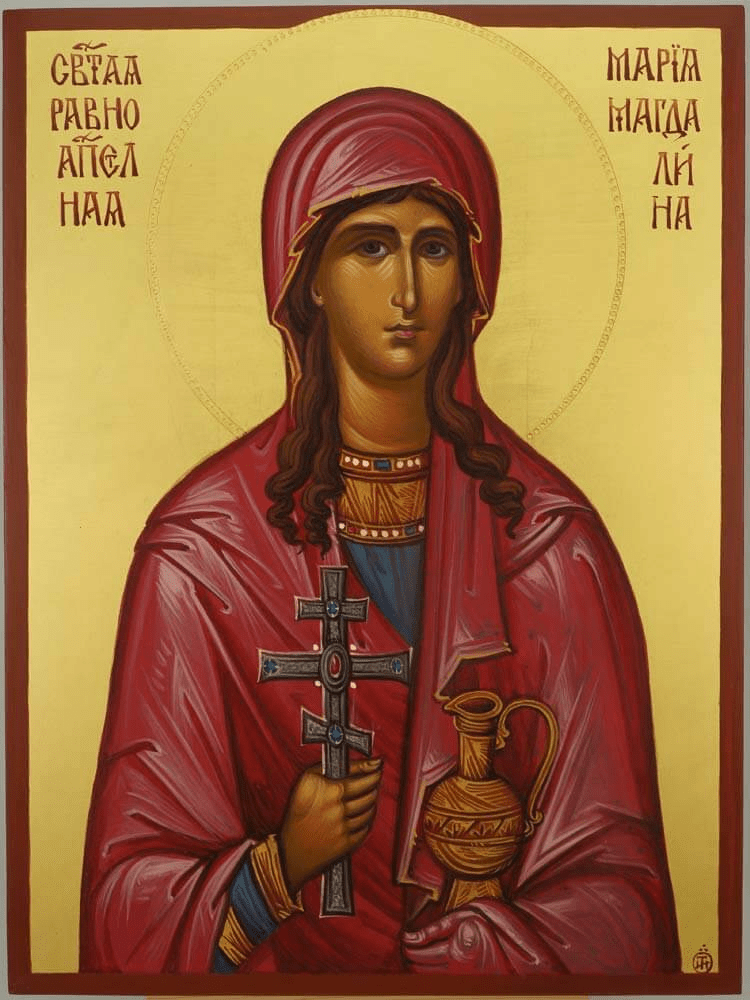
Saint Mary Magdalene
This is the Mary Magdalene the Church has honored for over 2,000 years …a faithful follower of Christ, the “Apostle to the Apostles,” and a model of repentance, humility, and love.
First to witness the Resurrection
Delivered from seven demons by Jesus (Luke 8:2)
Present at the Crucifixion and at the empty tomb
A repentant sinner and a woman of deep devotion
Honored as a saint and celebrated on July 22
Never portrayed romantically in Scripture
Her life was transformed by grace, not secret knowledge
Represents the power of mercy and true conversion
Gnostic Mary Magdalene (from the Gospel of Mary & other texts)
This is the reimagined Mary promoted by Gnostic writings and modern revisionists — not based on history, but on late, heretical texts written to push a very different theology.
Said to have received “hidden” teachings from Jesus
Depicted as superior in spiritual knowledge to the male apostles
Clashes with Peter in symbolic power struggles
Used as a literary tool to elevate Gnostic “gnosis” over apostolic truth
Often linked to feminist or romantic reinterpretations
Embraced by New Age and esoteric movements
Emphasis on spiritual elitism, not repentance
Contradicts the sacramental, incarnational faith of the Church
So, what do we do with the Gospel of Mary?
We recognize it for what it is: a non-canonical, Gnostic text that offers insight into early heresies, not early Christianity.
It was written well after the apostolic age and rejected by the Church Fathers, not because it was threatening, but because it simply wasn’t true. While it’s useful for studying what the early Church rejected, it’s not Scripture, and it doesn’t tell us who Mary Magdalene really was.
The real Mary Magdalene didn’t need secret knowledge or special status. She had Jesus, and that was enough.
1. Luke 8:2–3
“…Mary, called Magdalene, from whom seven demons had gone out, and Joanna… and Susanna, and many others, who provided for them out of their means.” Mary as a healed and devoted follower who materially supported Christ’s ministry.
2. John 20:16–18
“Jesus said to her, ‘Mary.’ She turned and said to Him in Aramaic, ‘Rabboni!’ (which means Teacher). Jesus said to her, ‘Do not cling to me… but go to my brothers and say to them…’ Mary Magdalene went and announced to the disciples, ‘I have seen the Lord!’” She is the first witness of the Resurrection — the “apostle to the Apostles.”
3. Mark 16:9
“Now when Jesus was risen early the first day of the week, He appeared first to Mary Magdalene, out of whom He had cast seven devils.” Confirms her deep deliverance and Christ’s choice to appear to her first.
St. Gregory the Great
“She longed for Him whom she thought had been taken away, and because she longed, she wept; and as she wept, she bent down… It was only right that she, who had loved so much, should see Him first.” Homilies on the Gospels
He affirms her deep love and devotion, connecting her to the repentant woman in Luke 7 (a common tradition in the West).
St. Augustine
“She was the first to see the risen Christ, and it was she who announced to the disciples the resurrection of the Lord.” Sermon 232
Emphasizes her essential witness to the Resurrection.
St. Anselm of Canterbury
“Blessed Mary Magdalene… chosen to be the first witness of the Resurrection, and the apostle to the apostles… May she obtain for us the grace to rise with Christ in newness of life.”
Beautiful invocation of her intercession and example.
In a world that’s changing faster than we can process, a strange and non-human new “song” is rising ; one sung not by poets, artists or prophets, but by machines.
It sounds like the beginning of a sci-fi movie, and in fact, it was. Terminator gave us Skynet: a cold, calculating superintelligence that became humanity’s worst nightmare. And while today’s AI doesn’t march with metal skeletons (yet), the unease remains. Many still hear the word “AI” and picture a machine uprising, not a writing, tech or organizational assistant.
They call them LLMs, Large Language Models. Tools like ChatGPT, Gemini, Grok, Bard, Claude, and others. These systems are trained on billions of words to write like humans, speak like us, and even sound wise.
People are using them for everything now- from writing songs to wedding vows, sermon outlines to school essays. Maybe you’ve used one yourself. I have. My knowledge is still limited, but I’m not avoiding AI. Maybe you’ve avoided them entirely. Maybe you haven’t decided if learning how to use LLMs is for you.Either way, since our world is rapidly integrating with these systems, I believe it is a good thing to understand what they are, and more importantly, how to stay grounded in a world where the use of AI is remaking our world.
What Is an LLM?
In simple terms, an LLM is a machine trained to predict language. It doesn’t understand what it says, but it knows what “usually comes next.”
It’s like a parrot who’s read every book ever written. It can quote Scripture, echo poetry, or imitate your favorite author- or even imitate you – but it doesn’t mean any of it.
You can ask it for:
A bedtime story
A job application
A haiku in the voice of Shakespeare
A prayer to soothe a hurting friend
And it will respond … in seconds.
But remember: It has no soul. No heart. No memory or experience of loss or love. And without the life that only God can give, it never, ever will.
Why Should You Care About LLMs and AI?
Because this isn’t just about technology. It’s about truth, beauty, and meaning, the things you were made for.
You’re not just a content consumer. You’re a creator, a mother, father, brother, sister, friend, HUMAN- a witness to something far deeper than algorithms. YOU ARE REAL.
And this moment in history is asking you:
Will you let the machine shape your voice? Or will you stay rooted in the true, good, beautiful, and holy? In real things that are a world away from artificial intelligence or artificial anything.
How to Stay Human in the Age of the Machine
1. Learn How It Works, Without Worshiping It
You don’t need to be a coder. But understanding that an LLM is just a glorified text predictor helps demystify the spell. It’s not magic. It’s math. And once you see that, you can start using it wisely, if you want to, as a servant, not a master. Or you might choose to pass, but at least you will be making an informed decision, based on knowledge instead of fear.
2. Use It as a Tool, Not a Crutch
Let it help you brainstorm or polish. Let it assist, never replace, your voice. If you’re an artist or entrepreneur, it can speed up the boring parts — but never outsource your soul.
3. Discern Between Echo and Truth
Let it help you brainstorm or polish stuff. Let it assist, but never replace, your voice. If you’re an artist or entrepreneur, it can speed up the boring parts… but never let it outsource your soul.
An LLM can imitate wisdom. But it can also mix truth with falsehood, charm with flattery, darkness with light. Keep your guard up. Compare its answers to Scripture. Check your sources. Don’t assume it’s right just because it’s articulate.
4. Teach Others the Difference
Your children, your friends, your readers, and many people are getting swept up in AI and LLMs and don’t know how to tell real from synthetic. If you’ve taken the time to understand, you can help anchor others so they don’t get swept away. You can be the lighthouse instead of an echo chamber.
5. Ground Yourself in Silence and Sacrament
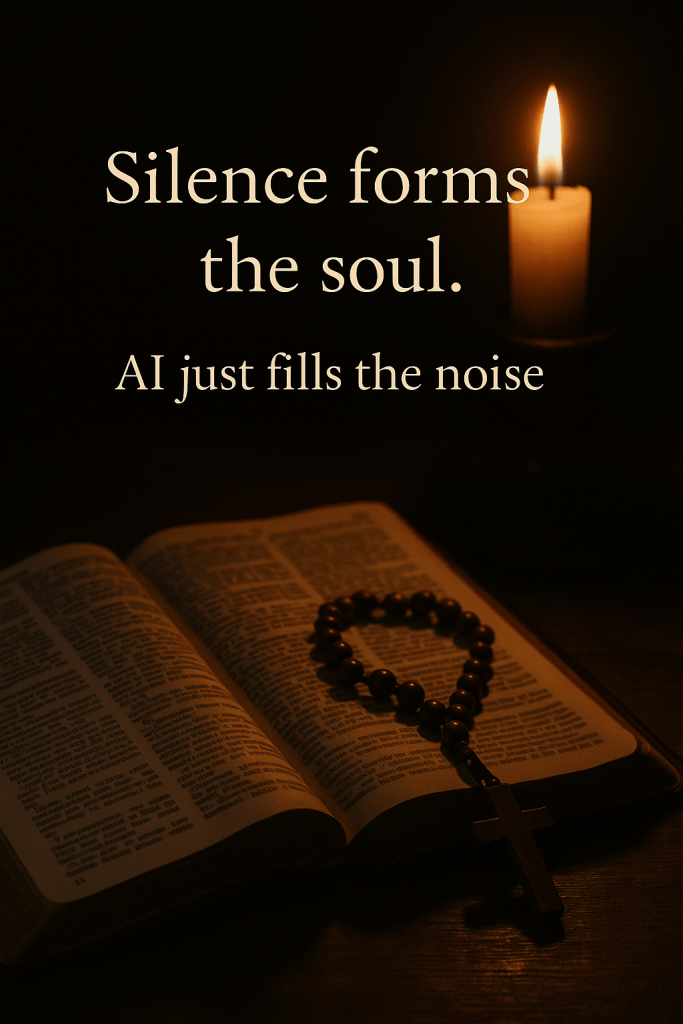
This one’s spiritual. LLMs talk endlessly, providing a constant stream of information and entertainment, while algorithms crave your attention, pulling you deeper into a digital abyss. But your soul needs silence, a chance to breathe and connect with God. It needs moments of prayer, whether in a quiet space at home, in nature, or at Mass. In these spaces, you encounter real beauty and nourishment that is far deeper than what can be found in the fleeting allure of virtual reality. Take time to unplug from the noise and distractions, letting yourself be formed by Heaven’s grace, wisdom, and peace, rather than merely fed by the superficial offerings of the world. Prioritize these moments, and you’ll find that your soul is enriched and your perspective transformed, creating a deeper connection to the divine and the world around you.
The Bottom Line
AI can help you find the right words for a sonnet. But it cannot mourn. It cannot ache with loss or tremble with love. It cannot kneel in prayer, nor glorify God…not from the heart, because it has none. It cannot be sanctified, cannot receive grace, cannot return affection with a soul behind it.
Yes, it can echo your voice. It can predict your rhythm, your phrasing, even your sorrow.But it cannot mean what you mean. Because it was never wounded. Never forgiven. Never saved.
How I Escaped the Cult of Modern Womanhood by the Grace of God
I once believed the lies. The shiny, well-packaged ones they call “empowerment.” The ones that parade as progress but are brewed in the dark cauldron of rebellion.
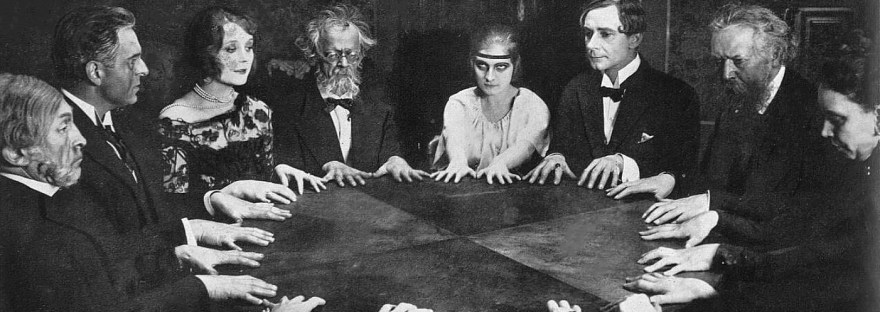
Feminism, as we know it today, didn’t emerge from love for women or for truth. It was born from a spiritual revolt, birthed by radical anti-Christian occultists, spiritists, sex magicians, and theosophists. Men and women alike, many of them witches and mediums, midwife-abortionists and Crowley disciples, unitied under the banner of “liberation” while dancing around ancient fires of demonic deception.
This isn’t conspiracy theory. It’s real history, and it comes with plenty of receipts.
Deuteronomy 18:10–12 “Let no one be found among you who…practices divination or sorcery, interprets omens, engages in witchcraft…Anyone who does these things is detestable to the Lord.”
Galatians 5:19–21 “Now the works of the flesh are plain: immorality…idolatry, sorcery…those who do such things shall not inherit the kingdom of God.”
Once you see it, the social engineering, the spiritual bait-and-switch – you can’t unsee it.
I drank that poison early. I believed the feminist revisionist fairy tales spoon-fed through textbooks and campus lectures. Even in my small mountain town of South Lake Tahoe in the 1970s, public school sowed the seeds. Later, at Portland State University, I enrolled in Women’s Studies and other subjects reimagined through a Critical Theory lens, which filled my mind with a thousand empty words about “the Goddess,” “choice,” and “self-actualization.”
I was an activist. I went to women’s marches and I corrected people’s political correctness. I lived it (although I was never pro-abort, which led me to be a bit of a reject in these feminist circles, and with pro-abort friends. It was this line of reason that made me start questioning Feminism).
I was a seeker. A serious Yoga practitioner, an Advaita (nondual) student, a daily meditator – for decades. A professional Tarot reader. I spoke with “spirit guides.” I cast spells. I practiced “white” magic, thinking it was harmless -holy, even. I studied the Vedas, was certified in many energy healing modalities, believed in manifestation, and obsessed over “The Secret,” believing I was creating reality with my mind.
Catechism of the Catholic Church, 2116–2117 “All forms of divination are to be rejected…consulting horoscopes, astrology, palm reading, interpretation of omens…recourse to mediums. These all conceal a desire for power over time, history, and, in the last analysis, other human beings…”
I learned 80% of all this from my mom (RIP). She loved Jesus but interpreted Scripture in her own way. She believed in healing crystals, psychic powers, spell casting, reincarnation and past life deceptions, soul mates and all the other New Age trappings that appeal so much to both our rebelliousness and our egos. She unwittingly followed the Gospel of Self. So did I. We were steeped in a false spirituality and didn’t know it. We thought we were good, powerful, and even godly (Goddess-ly).
But witchcraft in a soft and gentle voice is still witchcraft. And feminism, in its modern spiritual form, is one of its most seductive disguises.
Jeremiah 29:13 “You will seek me and find me; when you seek me with all your heart.”
It was only by the infinite mercy of God, the Divine Trinity, that my eyes were opened. That I repented. That I was pulled from that tangled web of lies. That I was freed from the cult of New Age feminist spirituality, and brought into the light of Christ.
St. Cyprian of Antioch(former sorcerer turned saint) “When the devil saw me become Christ’s soldier, he wept bitterly.”
2 Corinthians 5:17 “Therefore, if anyone is in Christ, he is a new creation; the old has passed away, behold, the new has come.”
Acts 3:19 “Repent therefore, and turn again, that your sins may be blotted out.”
St. Teresa of Avila “God withholds Himself from no one who perseveres.”
St. Mary Magdalene (Feast Day Reflection) “She loved much.” (Luke 7:47) Her redemption speaks to every woman delivered from the lies of the world.
This world is so loud with false promises. But Jesus and His Angels are always whispering to our soul. His voice breaks every spell.
I share all this not to boast of what I escaped, but to glorify the One who rescued me. I was not wise. I was not holy. I was deceived…heart, soul, and mind. But Jesus is the Good Shepherd, and He leaves the ninety-nine to find the one. He found me tangled in the thorns of counterfeit light and false liberation, and by His mercy, He cut me free. If He can redeem me, after decades of enchantment, spiritual pride, and false teaching, He can redeem anyone. No woman or man is too far gone, no soul too seduced. The lies are many, but the Truth is One. His name is Jesus Christ, and He alone sets captives free.
What the Saints really said about faith, reason, and science, and why the modern world has it backward.
We live in an age where faith and reason are often seen as enemies. But this is a modern confusion. The Christian Church, from her earliest days, has taught that both logic and faith come from the same divine Source.
The Catholic tradition deeply values reason as a gift from God, and the Logos as the foundation of both creation and rational thought. Below are some quotes you might find as deep and enlightening as I find them.
St. John the Evangelist
“In the beginning was the Word [Logos], and the Word was with God, and the Word was God.”
John 1:1
This foundational Scripture is where the concept of the Logos as Christ begins. “Logos” in Greek implies Word, Reason, Logic, and Order. The Church has always affirmed that Christ is the Logos through whom all things were made.
St. Augustine of Hippo
“Where I found truth, there I found my God, who is the truth itself.”
Confessions, Book X
Augustine frequently discusses how reason leads us to God because truth and reason are grounded in the Logos. He also wrote:
“Let us not seek to understand in order to believe, but believe that we may understand.”
This quote reveals the interplay between faith and reason…faith in the Logos brings deeper understanding, not irrationality.
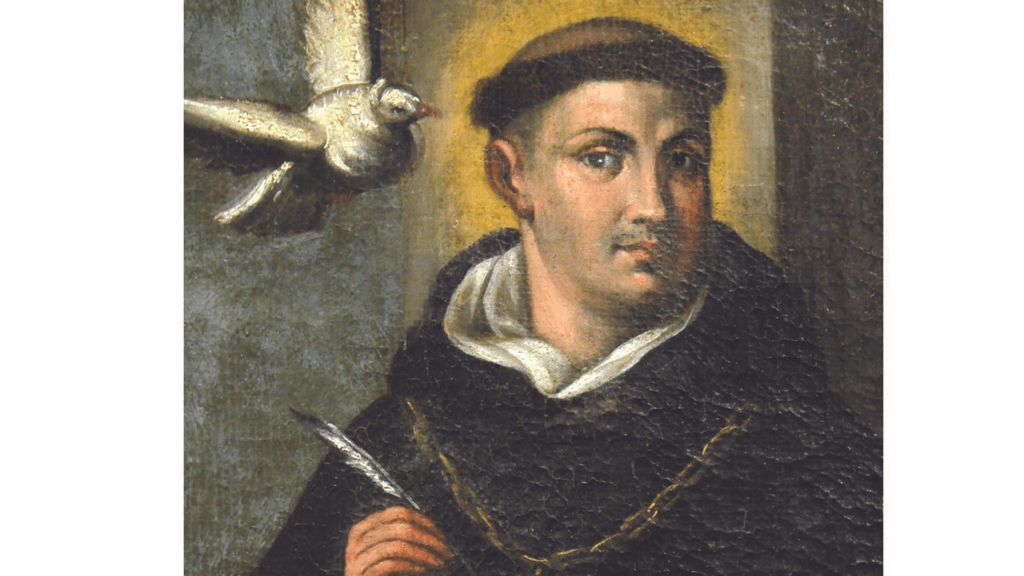
St. Thomas Aquinas
St. Thomas Aquinas is depicted in a painting at the Dominican House of Studies in Washington.
“The light of reason is placed by nature in every man, to guide him in his acts.”
Summa Theologiae, I-II, q.19 a.11
And also:
“All truth, by whomever it is spoken, comes from the Holy Spirit.”
Aquinas saw no contradiction between divine revelation and human reason. Logic is a participation in the Divine Logos.
St. Justin Martyr
“Whatever things were rightly said among all men, are the property of us Christians… For all the writers were able to see realities darkly through the sowing of the implanted word [Logos] that was in them.”
First Apology, 46
Justin Martyr, one of the earliest Christian philosophers, believed that the Logos was implanted in all men, making human reason a reflection of divine truth and natural law.
Pope Benedict XVI
While not canonized yet, Pope Benedict is widely quoted and revered as a saintly theologian. He said:
“Faith in the Logos, in creative Reason, is the basis of the Christian faith.”
Regensburg Address, 2006
This speech powerfully defended the harmony between faith and reason, arguing that the rejection of reason leads to violence and irrationality.
The Logos (Word) is Christ Himself: eternal, rational, the source of all truth that is found in creation. Logic is rooted in Logos, which is Christ, the Word made flesh.
Science Unwraps the Gift of God’s Creation
If Christ is the Logos, the Divine Logic behind all things, then creation is not random. It is intelligent, orderly, and knowable because God made it that way. He speaks creation into being, and what He speaks can be understood by we who are created in His image.
This is why science, when rightly ordered, is not a threat to faith. It is a form of reverent curiosity. It’s the mind of man investigating the works of God, like a child reading the handwriting of their Father.
Here’s how the saints and the Church have spoken of science:
St. Albert the Great (Doctor of the Church and patron of scientists)
“The whole world is theology for us, for the heavens proclaim the glory of God.”
Albert saw the natural world as a living work, not in competition with Scripture, but echoing it. He believed scientific inquiry was a form of praise.
St. Thomas Aquinas
“The study of philosophy [and by extension science] is not undertaken in order to believe, but rather to understand that which we believe.”
Aquinas saw no wall between theology and science, only different lenses for beholding the same reality: God’s creation.
St. John Paul II
“Science can purify religion from error and superstition; religion can purify science from idolatry and false absolutes.”
Letter to the Director of the Vatican Observatory, 1988
A warning and a promise. Faith and reason must work together, each keeping the other healthy and honest.
Pope Benedict XVI
“Science must rediscover its connection to the Logos, to reason, and to the Creator.”
Homily, 2006
He taught that science unmoored from the Logos becomes dangerous, but that true science is a noble and sacred path toward truth.
Catechism of the Catholic Church (no. 159)
“Though faith is above reason, there can never be any real discrepancy between faith and reason. Since the same God who reveals mysteries and infuses faith has bestowed the light of reason, God cannot deny Himself, nor can truth ever contradict truth.”
This is the cornerstone of Catholic intellectual life: truth is never at war with itself. If it’s real science, and real faith, it will harmonize.
In the eyes of the Church’s great saints, science is a sacred curiosity. It is the soul stretching its eyes toward the stars, or into the cell, or into the atom…and quietly asking, “How did You do it, Lord?”
It is the Logos that gives the world its order, and Love that gives it meaning.
Oh Jesus, I surrender myself to you, take care of everything
We are learning how to record in our home studio…so challenging but it is finally coming along!
This timeless Gershwin standard has been close to our hearts for years, especially mine because it was the first song I learned to sing with my old friend and mentor, Jim Aton.
“Grace and the Gentleman” is my new duo with Mark Wilson, who I have been making music with since ’99! We are in the process of recording all of our originals and favorite covers.
Booking for weddings and special occasions. We have a large eclectic repetoire that draws from bygone era jazz to modern standards, blues, Americana, rockabilly, classic rock (done our own way), as well as originals.
For most of my life, I’ve worn the identity of an anti-war activist like a badge stitched into my soul. Since the ’90s, that was how I saw myself before almost anything else. After 9/11, I even created a blog (which was fairly popular I might add) called Evolutionary Means, where I shared thoughts under the motto: “Peace is a constant, even as the bombs fall.”
But as the years have gone by, I’ve come to see things a bit differently.
Peace…true peace…is not the constant.
War is.
As sad as my heart is to realize this, this thing that I hate more than anything, war – has always existed in this world of men, and it will exist until the very end. Isn’t it written into the ancient cracks of this broken earth?
Sometimes we try to resist it, to stop the dark and evil depths of the human soul, but the older I get, the more I understand: this world itself is not really ours to control.
It often feels like we are but vanishing whispers on the wind, unseen specks of dust on the back of something so much larger and more terrifying than any of us small people can even fathom.
A beast, if you will, and it devours us without apology. And it’s such a constant, and such a constant background noise, that we are unaware of it. We cannot see the beast that enslaves the world.
But still…still, I believe we are called to become peace…to become like Jesus.
To carry His peace within our hearts. To offer it in our homes. To sing it, speak it, and live it the very best we can …even as the bombs fall. Even when they are falling in our own back yards..
It’s not easy. In fact, it might be the hardest thing of all. But I believe it matters more than anything, to carry the peace of Christ within our hearts..This is what we’re here to do, first and foremost. To go so deep within the heart of Jesus, that we come to embody His peace in a realm where unfathomably dark and evil things exist. Like war.
Even as the world keeps on turning with sorrow and despair, there is true beauty in the soul who chooses gentleness and peace. Who chooses love. Who chooses Jesus.
Even now, especially now, I want to be that soul, childlike in my trust in God, and full of His Peace, even as the bombs fall.
Praying for peace in the hearts of all men and women.
In the name of the Father, and of the Son and of the Holy Spirit, Amen





















 gracearmstrong.art