“Those who deny that the Son is God, deny the Father also.”St. Athanasius, the “hammer” of the Arians
Christ Pantocrator, Monastery of St. Catherine, Sinai (6th century)
If Jesus Christ were a creature—made, and not begotten—then He would not be God.
And if He is not God, there is no salvation. Because no creature can save another creature.
Only God saves.
This is the entire point of the Nicene Creed:
“God from God, Light from Light, True God from True God, begotten not made, consubstantial with the Father.”
Why did the Church fight so fiercely against Arianism?
Because Arianism destroys Christianity at its root. It turns Christ into a kind of “super-angel,” which means the Incarnation was not God Himself taking on our nature; just some spiritual middle-manager pretending to be God. That is blasphemy.
What is the Heresy of Arianism?
Arius – 4th Century Priest and Heretic:
“The Son is not eternal or co-eternal or co-unbegotten with the Father. He did not exist before He was begotten. The Son has a beginning, but God is without beginning.”
Arianism is the ancient heresy that claimed Christ was not truly God, but a created being—exalted, powerful, even heavenly, but not equal with the Father.
It began with Arius, a 4th-century priest who could not accept the mystery that the Son is eternally begotten, not made. By calling Christ a creature, Arianism stripped the Incarnation of its meaning and reduced the Cross to the death of a mere man. The Church recognized immediately that this was not a minor theological mistake, but a denial of Christianity itself—and the early councils fought it with everything they had.
Watch this short video about the history of Arianism
These passages alone are fatal to Arianism:
John 20:28 Thomas does not call Him “a messenger.” He calls Him: “My Lord and my God.” Colossians 2:9 “For in Christ the fullness of the Godhead dwells bodily.“ Titus 2:13 “Waiting for the appearance of the glory of our great God and Savior, Jesus Christ.“
This is why the Church did not treat Arianism as a harmless philosophical disagreement.
The Nicene Creed (325 A.D.)
We believe in one Lord Jesus Christ, the only-begotten Son of God, God from God, Light from Light, true God from true God, begotten, not made, consubstantial with the Father.
It goes straight to the heart of the faith. If Christ is not God, then the entire structure of Christianity falls apart—not gradually, but all at once. The Sacraments, the Gospel, the hope of salvation itself; all of it depends on the truth that the Son is of the same divine substance as the Father.
If Christ is not God, then every sacrament collapses. Not “becomes diminished” — but collapses, and here is why:
Because:
1. The Cross
If Christ is only a creature, then the Cross is the suffering of just another man.
The Crucifixion — Fra Angelico (c. 1440–1445)
• A creature cannot bridge the infinite gap between fallen humanity and the Almighty God.
• A creature’s death cannot atone for the sins of the world.
• A creature cannot offer a sacrifice of infinite value.
So the Cross, without Christ’s divinity, becomes:
• A tragic execution.
• A martyrdom at best.
• A symbolic gesture with no real power.
If the Cross has no divine power, then there is no redemption and we remain bound to our sins, with no chance of salvation.
2. The Eucharist
If Christ is not God, then:
• The Eucharist cannot be His Body.
• It cannot be His Blood.
• It cannot convey grace.
• It cannot transform the soul in holiness.
At that point, we are merely eating bread and performing a sentimental reenactment of the Last Supper.
No Real Presence.
No Communion with God.
Just a ritual meal between creatures.
The entire foundation of Christian worship becomes a hollow performance.
“The Son is not like the Father by grace, but by nature. He is God from God.”
3. Baptism
If Christ is not God, then Baptism is:
• Not a rebirth.
• Not a washing of sin.
• Not a joining to Christ’s Body, the Church.
Because a creature cannot give the Holy Spirit, and Baptism is only regenerative by the Holy Spirit.
St. Cyril of Alexandria
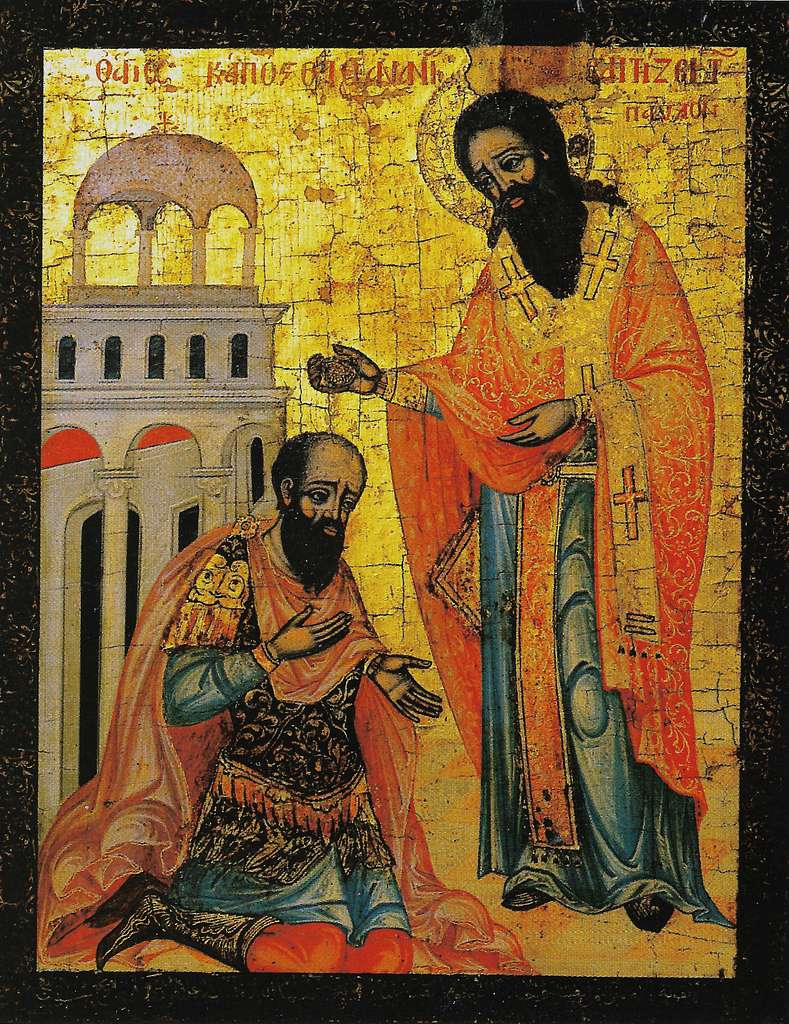
Baptism of Paul the Apostle (Germany)
So if Christ is not God, then Baptism is just:
• Bathwater and empty tradition.
• Ceremony and empty tradition.
• Social initiation and empty tradition.
• A symbolic gesture that does nothing and is merely empty tradition.
No grace. No new creation. And no adoption as sons and daughters of God.
⸻
St. Gregory of Nazianzus (The Theologian): “What is not assumed is not healed.” If Christ is not truly God and truly man, the human race is not saved.
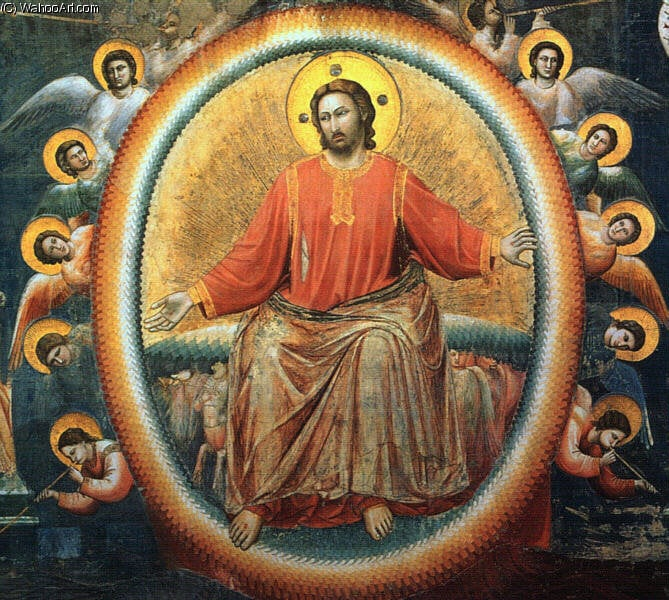
The Last Judgement, detail of Jesus, 1305-13, Fresco,
The Entire Faith Stands or Falls on This One Truth
If Christ is not God:
• Incarnation is a myth.
• Salvation is a myth.
• Every sacrament is empty of grace, and only a myth.
• The Church has no authority, and Scripture is nothing but a beautiful MYTH.
This is why the Church Fathers fought Arianism so adamantly. Because the denial of Christ’s divinity is not a small error; it is the total annihilation of Christianity.
Either Christ is God, or Christianity is false.
There is no middle ground.
Which is why the Nicene Creed does not hedge its words:
“True God from True God, begotten not made, consubstantial with the Father.”
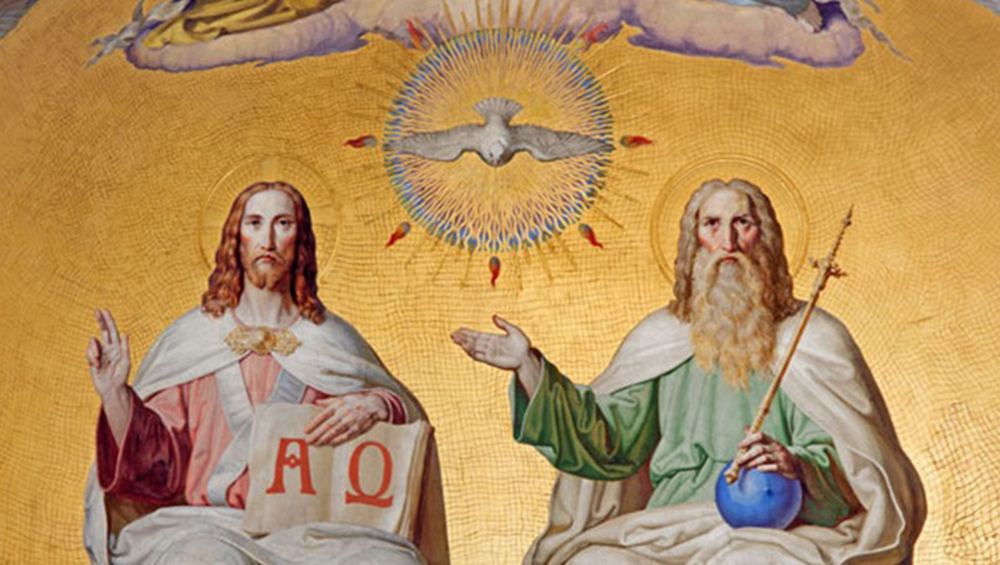
The Holy Trinity – 1460 Laurent Girardin
This is not poetry, but a line drawn in the bedrock of the Church. Cross it; and you have stepped out of the Christian faith and into heresy.
St. Athanasius— the hammer of the Arians: “If the Son is a creature, then we are worshiping a creature. But if we worship a creature, we are no longer Christians.”
“He became what we are that He might make us what He is.” (i.e., divinization is impossible unless He is God.)
A Christianity where Christ is not God is no Christianity at all. It is a hollow shell with the name “Jesus” — who is an IMPOSTER and not the True Jesus – pasted on it.
This is why the Church draws the line here—hard and clear.
Either:
Christ is the Eternal Son, one in being with the Father, or you are outside the Christian faith.Not because of arrogance; but because Truth has boundaries that cannot be crossed. And this boundary is the cornerstone of the whole structure of Christianity.
Arianism is NOT Christianity.
Saint Nicholas Slapping Arius –– Public Domain
St. Augustine: “If Christ were not God, He could not be the Mediator of God and men.”
And so the question is not merely doctrinal — it is personal. If Christ is God, then He is not merely a teacher to admire, but a Lord to worship. He is the One before whom every knee shall bow. He is the Lamb upon the Throne. He is the Alpha and the Omega.
We either receive Him as True God, or we create a false christ in our own image.
There is no middle Christ. There is no halfway divinity. There is only the Eternal Son — or an idol.
Therefore:
Let us confess Him boldly. Worship Him rightly. And never be ashamed of the creed that proclaims Him.
“My Lord and my God.” (John 20:28)
In the name of the Father, and of the Son, and of the Holy Spirit. Amen.
— Grace
Christ’s Appearance to Mary Magdalene after the Resurrection by Alexander Ivanov
As churches burn across Sudan, believers cling to the only liberty no tyrant can steal: FAITH
“If one member suffers, all suffer together.”— 1 Corinthians 12:26
True love is never safe. It is sacrificial.
It bleeds, forgives, and endures for the sake of another. The persecuted Christians of Sudan are living proof of this — men, women, and children who cling to Christ even when the cost is everything.
As St. Maximilian Kolbe once said:
“Love lives by sacrifice, and the more a soul loves, the more it will sacrifice.”
The world calls it tragedy, but Christianity calls it love perfected; the kind of love that turns suffering into an offering, and persecution into prayer.
Self-giving love.
“You cannot love the truth and not suffer for it.” St. Catherine of Siena
The Crisis
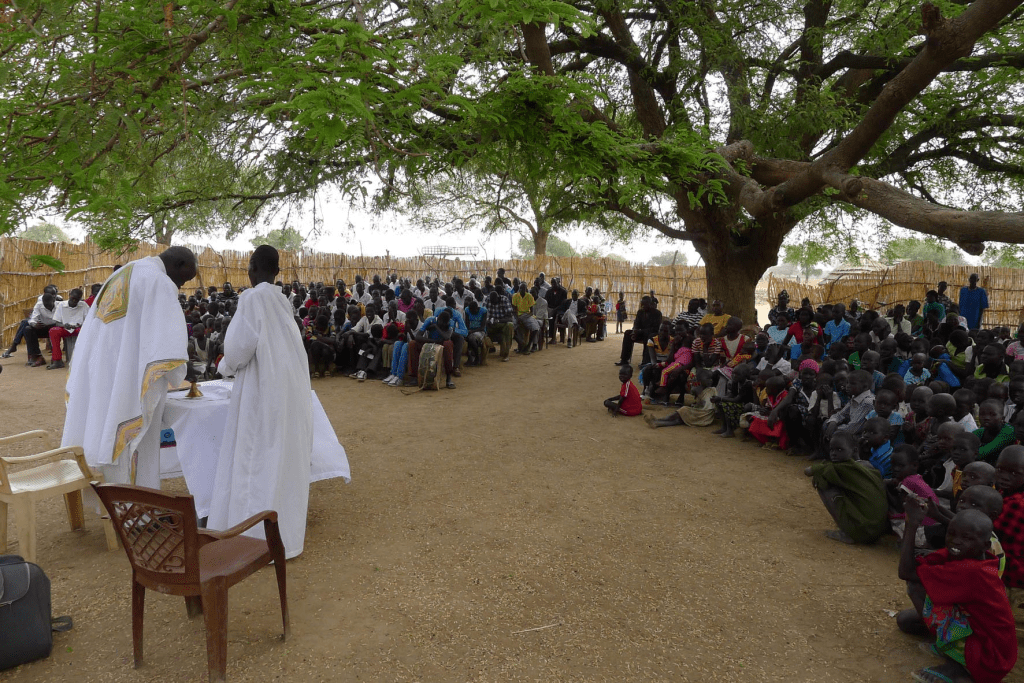
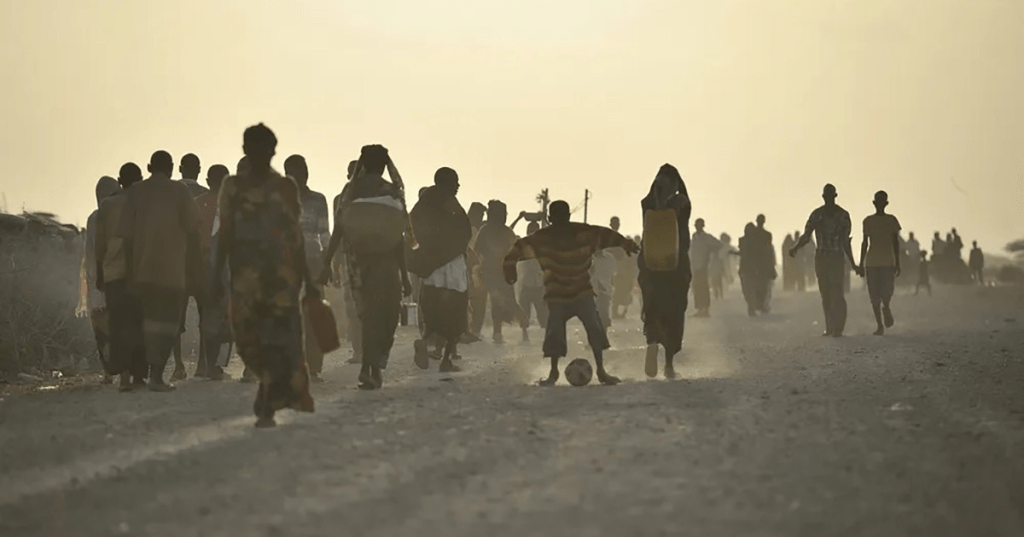
Across Sudan, Christian families are enduring a storm of horrific persecution and grief.
Churches bombed. Pastors tortured. Families fleeing through burned villages with nothing but the cross around their necks.
The war between the Sudanese Armed Forces and the Rapid Support Forces has become a shadow war against the Church itself; a campaign of destruction driven by militant ideology and decades of totalitarian Sharia rule.
In June 2025, three churches in North Darfur were bombed, killing the faithful at prayer.
Over a hundred Christian sites have been seized and desecrated.
Christians are arrested, beaten, and forced into hiding.
Some now meet in secret, worshipping beneath the sound of shellfire.
This is not just politics. It is a war on the human soul; on the freedom to believe, to love, and to live in peace as children of God.
⸻
What We Must Remember
A society that removes individual choice cannot sustain freedom.
And when belief is punished, all human action becomes enslaved.
Sudan shows what happens when a nation replaces the religious freedom with totalitarianism and government coercion: freedom dies, dignity collapses, and poverty spreads like plague.
We who live in relative peace must not look away.
Their suffering is a warning….and a call to crush totalitarian systems before they have time to flourish.
⸻
A Call to Prayer
Pray for the men trying to protect their families, widows and orphans, for pastors in hiding, for the traumatized children of war who have seen their churches and families reduced to ash.
Pray for courage among those who still choose Jesus even when it costs them everything. Sacrificial love is the greatest love there is!
Pray for conversion of hearts among those who persecute them.
And pray that freedom — both of faith and of conscience — may rise again in Sudan.
“The blood of the martyrs is the seed of the Church.”
May that seed, watered by tears and faith, bloom again on Sudanese soil.
O God of all power and mercy, who gave Your Son to bear the Cross for the salvation of the world, look with compassion upon Your servants who suffer for your name’s sake.
Strengthen their faith, increase their hope, even as they are martyred, and grant that their patient endurance may lead many souls to conversion. Protect them by Your grace and bring them to the joy of eternal peace.
Through our Lord Jesus Christ, Your Son, who lives and reigns with You in the unity of the Holy Spirit, God, forever and ever. Amen.
One of the most beautiful things about being Catholic is seeing how the Old Covenant is not discarded, but fulfilled in the New Covenant, in Christ. I love how the Old Testament is full of shadows, symbols, and prophecies that find their completion in the New Covenant. Yom Kippur, “the Day of Atonement”-is one of the most striking examples.
Below is a simple explanation of the Jewish meaning of Yom Kippur and how Catholics understand its fulfillment in Jesus Christ.
The Meaning of Yom Kippur (Jewish Understanding)
Yom Kippur is the holiest day in the Jewish calendar. It falls shortly after Rosh Hashanah and is dedicated entirely to repentance, reconciliation, and atonement. Traditionally, it includes:
A 25-hour total fast (no food or water)
Abstaining from work
Public confession of sin
All-day prayer and synagogue services
Seeking forgiveness from both God and others
In ancient Israel, Yom Kippur was the one day when the High Priest would enter the Holy of Holies to make atonement on behalf of the people (Leviticus 16).
Two goats were offered:
One was sacrificed, its blood sprinkled inside the sanctuary.
The other… the “scapegoat” … had the sins of the people symbolically laid on it and was sent into the wilderness to die.
A bull was also sacrificed for the priest’s own sins. The ritual restored the people to covenantal purity before God.
How Catholics See Yom Kippur Fulfilled in Christ
The Church doesn’t abolish the meaning of Yom Kippur, but recognizes that its deepest purpose was completed by Jesus.
Christ is the True High Priest
“We have a great high priest, Jesus the Son of God… He entered once for all into the Holy Place.” — Hebrews 4:14, 9:12
Just as the High Priest entered the Holy of Holies once a year, Jesus entered the true heavenly sanctuary – not with animal blood, but His own.
Christ is the Sacrifice
“He has appeared once for all at the end of the ages to put away sin by the sacrifice of himself.” — Hebrews 9:26
The goats and bulls were temporary symbols. Christ is the eternal offering, “He who takes away the sins of the world.”
Christ as the Lamb of God , the New “Scapegoat”
“The Lord has laid on Him the iniquity of us all.” — Isaiah 53:6
Jesus is the one who carries our sins away…outside the city, onto the Cross, and into the tomb, as the Lamb of God.
The Day of Atonement Becomes Good Friday
Yom Kippur was a yearly event. Christ’s sacrifice is “once for all.” Catholics live the fulfillment of that atonement in:
The Mass – the one sacrifice made present
Confession – the personal application of Christ’s atonement
Good Friday – the true Day of Atonement for the world
As St. Augustine famously said:
“The New Testament lies hidden in the Old, and the Old is unveiled in the New.”
And St. Thomas Aquinas reminds us:
“All things in the Old Law were figures of Christ.”
This is why the Catholic Church doesn’t reenact Yom Kippur as a ritual – its meaning has already reached its fulfillment in the Passion of Christ.
Side-by-Side: Yom Kippur and Its Fulfillment in Christ
Old Covenant (Yom Kippur)
New Covenant (Christ)
High Priest enters the Holy of Holies once a year
Christ enters the heavenly sanctuary once for all (Hebrews 9:12)
Goat sacrificed for sins of the people
Christ becomes the perfect sacrificial Lamb (John 1:29)
Scapegoat carries sins into the wilderness
Christ bears our sins and is crucified outside the city (Isaiah 53:6, Hebrews 13:12)
Animal blood sprinkled on the mercy seat
Christ offers His own blood (Hebrews 9:14)
Yearly ritual of atonement
One eternal sacrifice (Hebrews 10:10)
Confession and fasting
Confession and penance in the Sacrament of Reconciliation
Temple sanctuary
Heavenly sanctuary and the Church as His Body
Covenant renewed temporarily
Covenant fulfilled eternally
What This Means for Catholics
We don’t look at Yom Kippur as something foreign to our faith; it’s part of our roots in salvation history. It prepares the world for Christ.
Good Friday becomes the true Day of Atonement.
The Mass is the living memorial of the one sacrifice.
Confession is our personal participation in the atonement He won.
Fasting and penance continue the spirit of repentance the day was meant to inspire.
As Pope Benedict XVI put it:
“Jesus does not abolish the Old Testament; He brings it to fulfillment by giving it its definitive interpretation.”
And the Catechism confirms it:
“The sacrifice of Christ and the sacrifice of the Eucharist are one single sacrifice.” — CCC 1367
Conclusion
Yom Kippur shows us the yearning of Israel for a true and lasting atonement. In the New Covenant, that longing is not rejected – it’s completed.
I love seeing how the Old Testament foreshadows Christ, and how the New Covenant fulfills what the Old began. The shadows have become substance. What was done once a year in symbol is done once for all in truth.
Christ is our High Priest, our Sacrifice, the Lamb of God who takes away the sins of the world. And He didn’t just enter the sanctuary of stone – He opened Heaven.
In the Gospel of John (1:29), John the Baptist exclaims, “Behold, the Lamb of God, who takes away the sin of the world,” referring to Jesus Christ. This phrase identifies Jesus as the perfect, sacrificial Lamb, an echo of the temple sacrifices, signifying that his death on the cross provides atonement for humanity’s sins and offers salvation.
St. Francis de Sales “The measure of love is to love without measure.”
The latest horrors in the news made me stop and think about forgiveness.
People argue: Should unrepentant murderers be forgiven?Is that even possible?
I honestly don’t know if absolute forgiveness is possible for all of us. But the question reveals something deeper to me: how little most people actually know about Christianity.
Because the truth is this; Christianity is not a puddle. It is an ocean.
The Shallows
Before I converted, I thought I knew Jesus. I thought I knew Christianity. But looking back, I was only splashing in a puddle beside the ocean. I had the childish basics: “Be kind. Forgive. Love everyone. Be compassionate.”
But that’s not the fullness of Christianity by a longshot. That’s basic morality- the same lessons any parent might teach a toddler. It has depth, but only ankle-deep.
I have noticed that many cradle Catholics seem to live in this shallow place permanently, never going beyond their first lessons. They know about Mass, but not why it matters. They know they should pray, but they rarely do. They may even be devout in appearance but never venture beyond the shore. They believe that their catechesis, their Christian education and formation ended in childhood.
The Depths
Little by little I have begun to wade deeper.
Real catechesis and deep formation to Christ is like being swept out to sea…overwhelming at first, even frightening. The Jesus I discovered as I studied and prayed -more and more – was not the Jesus I had imagined as a spiritual infant. In fact, Christianity is infinitely richer, truer, more beautiful than I ever dreamed. It is a course of study on par with earning multiple PhDs over a lifetime, yet with one difference: it is Divine.
I am still at the high school level, if that – I have so much to learn. It is deeply humbling.
But the deeper I go, the more it transforms me. Virtues are no longer nice ideas but are like muscles that must be strengthened. Forgiveness, for example, is no longer me just saying “I forgive you.” As I grow in the virtue of forgiveness, I can feel myself stretching my childish understanding of it into what hopefully may someday become saintly forgiveness, where my soul learns to forgive as God forgives, as Jesus forgave on the cross. As Jesus forgives me every day.
This doesn’t happen by accident. It happens through grace, discipline, prayer, and daily practice. My formation to the Divine Logos may extend after my life here is over, in the purification of Purgatory – before I am purified enough to receive the Beatific Vision. I will be grateful for this should it be in my soul’s journey to meet God face to face!
Why Most Christians Stay Shallow
This age worships ease and comfort, and we blindly project this love of convenience onto our faith. Many Christians cling to the “once saved, always saved” idea of salvation -a spiritual shortcut that feeds sloth and makes prayer, regular repentance, confession, discipline and receiving the sacraments seem unnecessary.
Even many Catholics nowadays live as though comfort is the highest good. They skip confession for years. They go to Sunday Mass or Easter Mass- out of habit or tradition but rarely pay much attention to God, never try to deepen their prayer life or read the Bible, and never make an actual effort to train their souls in virtue.
This is why modern Christians look at forgiveness and virtue as impossible ideals instead of living realities. They never left the shallows.
How to Go Deeper (Even in the Novus Ordo)
Matthew 7:24–25 “Everyone then who hears these words of mine and does them will be like a wise man who built his house upon the rock… and it did not fall, because it had been founded on the rock.”
Some Catholics despair, thinking the loss of the Latin Mass or the spirit of Vatican II has left us stranded. But that’s not true. You can be a traditional, devout Catholic even in the Novus Ordo, if you take the call seriously.
Go to daily Mass whenever possible.
Pray unceasingly. THIS IS KEY. Pray the rosary daily. Learn mental prayer to pray like the saints. Set a daily rhythm of prayer that cannot be broken.
Read Scripture as living Word, not as occasional inspiration. Let the Scriptures speak to your heart.
Go to confession regularly and receive the Eucharist as often as possible. Purification of your soul is not optional.
Fast and forsake worldly attachments. Sacrifice is part of being Christian. Carrying your cross is part of being like Jesus!
Live as though your vocation is to become a saint – because it is.
This is the saint’s journey. It is hard. It is not convenient. But it is the only way to move from puddle-splashing to swimming in the depths.
Hebrews 5:14 “But solid food is for the mature, for those who have their faculties trained by practice to distinguish good from evil.”
The Ocean Awaits
When I look back at what I once thought Christianity was, I almost laugh. I thought I was in the ocean, but I was playing in a muddy puddle. And that is where way too many modern Christians still remain, arguing about things they don’t even understand, like children arguing physics with a PhD in physics.
But if we dare to dive deeper, if we who love God with all our hearts take up discipline, prayer, and the pursuit of virtue, we will discover that Christianity is not shallow at all. It is endless, infinite, and alive.
The Halls of Learning Have Become Temples of Inversion
I saw through the communist indoctrination in college back in the ’90s. It made me sick. I dropped out and got a job as a cocktail waitress at Harvey’s Lake Tahoe.
I went on to work many odd jobs singing, waiting tables, selling timeshare, selling other products, but I never settled on a career path. Nothing felt right.
I’ve watched ever since as that indoctrination machine only got more powerful, more invasive, more demonic.
Most young people then and now have been surrounded by well-meaning voices of family, friends, and mentors who subtly (or not so subtly) pressure them to prove their worth by going down the path of “higher education.”
But let’s be honest: Most of us can’t afford to send our children to the rare Christian or conservative colleges that still stand. And even those aren’t perfect.
The pressure to conform, to bow before the cult of the radical left, the one that controls almost every university and public institution, is suffocating. The options so few and frankly either intimidating and out of reach for most people – or demeaning, uninspiring, and miserably unpleasant.
And it is not neutral.
It is not kind.
It is not tolerant.
It is demonic. Full stop.
This is the upside-down spirit of the age: A loveless, cruel, anti-human, eugenic and sickly secular ideology that wants to tear our children from truth, from beauty, from natural law, and from God Himself.
If you don’t believe in God yet, fine. But you’d have to be blind not to see that something truly evil is loose in the world.
Something that hates the good.
Something that mocks and murders innocence.
Something that calls what is pure “hateful” and what is perverse “liberating.”
I believe it’s demons.
You may not believe in them, but they believe in you. They know how to invisibly influence you and harm you through your desires, your thoughts and emotions. Your vices. Your sins.
This is a spiritual war for your soul, and if you can’t see that yet, I beg you:
Open your soul.
Stop scrolling.
Get silent.
PRAY.
Because the Spiritual War is real, and our children’s souls are on the front lines, and ours are too.
Mary Magdalene has become one of the most misunderstood figures in all of Christian history, not because of what the Church teaches, but because of what modern fiction, films, and fringe theories have invented.
You’ve probably heard whispers about “lost gospels,” secret teachings, and a supposed romantic relationship between Jesus and Mary Magdalene. Much of this comes from a Gnostic text called The Gospel of Mary, written long after the time of Christ and rejected by the early Church. It doesn’t reflect apostolic Christianity, it reflects Gnosticism, a spiritual counterfeiting movement that’s been twisting the truth since the early centuries.
Let’s separate the truth from the hype.
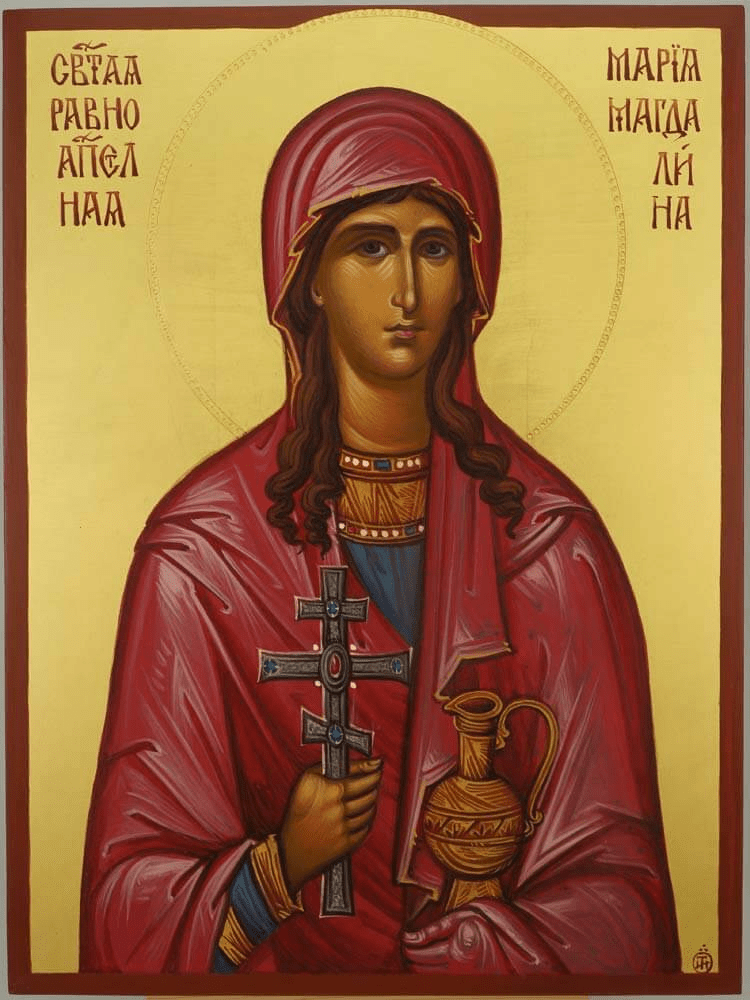
Saint Mary Magdalene
This is the Mary Magdalene the Church has honored for over 2,000 years …a faithful follower of Christ, the “Apostle to the Apostles,” and a model of repentance, humility, and love.
First to witness the Resurrection
Delivered from seven demons by Jesus (Luke 8:2)
Present at the Crucifixion and at the empty tomb
A repentant sinner and a woman of deep devotion
Honored as a saint and celebrated on July 22
Never portrayed romantically in Scripture
Her life was transformed by grace, not secret knowledge
Represents the power of mercy and true conversion
Gnostic Mary Magdalene (from the Gospel of Mary & other texts)
This is the reimagined Mary promoted by Gnostic writings and modern revisionists — not based on history, but on late, heretical texts written to push a very different theology.
Said to have received “hidden” teachings from Jesus
Depicted as superior in spiritual knowledge to the male apostles
Clashes with Peter in symbolic power struggles
Used as a literary tool to elevate Gnostic “gnosis” over apostolic truth
Often linked to feminist or romantic reinterpretations
Embraced by New Age and esoteric movements
Emphasis on spiritual elitism, not repentance
Contradicts the sacramental, incarnational faith of the Church
So, what do we do with the Gospel of Mary?
We recognize it for what it is: a non-canonical, Gnostic text that offers insight into early heresies, not early Christianity.
It was written well after the apostolic age and rejected by the Church Fathers, not because it was threatening, but because it simply wasn’t true. While it’s useful for studying what the early Church rejected, it’s not Scripture, and it doesn’t tell us who Mary Magdalene really was.
The real Mary Magdalene didn’t need secret knowledge or special status. She had Jesus, and that was enough.
1. Luke 8:2–3
“…Mary, called Magdalene, from whom seven demons had gone out, and Joanna… and Susanna, and many others, who provided for them out of their means.” Mary as a healed and devoted follower who materially supported Christ’s ministry.
2. John 20:16–18
“Jesus said to her, ‘Mary.’ She turned and said to Him in Aramaic, ‘Rabboni!’ (which means Teacher). Jesus said to her, ‘Do not cling to me… but go to my brothers and say to them…’ Mary Magdalene went and announced to the disciples, ‘I have seen the Lord!’” She is the first witness of the Resurrection — the “apostle to the Apostles.”
3. Mark 16:9
“Now when Jesus was risen early the first day of the week, He appeared first to Mary Magdalene, out of whom He had cast seven devils.” Confirms her deep deliverance and Christ’s choice to appear to her first.
St. Gregory the Great
“She longed for Him whom she thought had been taken away, and because she longed, she wept; and as she wept, she bent down… It was only right that she, who had loved so much, should see Him first.” Homilies on the Gospels
He affirms her deep love and devotion, connecting her to the repentant woman in Luke 7 (a common tradition in the West).
St. Augustine
“She was the first to see the risen Christ, and it was she who announced to the disciples the resurrection of the Lord.” Sermon 232
Emphasizes her essential witness to the Resurrection.
St. Anselm of Canterbury
“Blessed Mary Magdalene… chosen to be the first witness of the Resurrection, and the apostle to the apostles… May she obtain for us the grace to rise with Christ in newness of life.”
Beautiful invocation of her intercession and example.
How I Escaped the Cult of Modern Womanhood by the Grace of God
I once believed the lies. The shiny, well-packaged ones they call “empowerment.” The ones that parade as progress but are brewed in the dark cauldron of rebellion.
Feminism, as we know it today, didn’t emerge from love for women or for truth. It was born from a spiritual revolt, birthed by radical anti-Christian occultists, spiritists, sex magicians, and theosophists. Men and women alike, many of them witches and mediums, midwife-abortionists and Crowley disciples, unitied under the banner of “liberation” while dancing around ancient fires of demonic deception.
This isn’t conspiracy theory. It’s real history, and it comes with plenty of receipts.
Deuteronomy 18:10–12 “Let no one be found among you who…practices divination or sorcery, interprets omens, engages in witchcraft…Anyone who does these things is detestable to the Lord.”
Galatians 5:19–21 “Now the works of the flesh are plain: immorality…idolatry, sorcery…those who do such things shall not inherit the kingdom of God.”
Once you see it, the social engineering, the spiritual bait-and-switch – you can’t unsee it.
I drank that poison early. I believed the feminist revisionist fairy tales spoon-fed through textbooks and campus lectures. Even in my small mountain town of South Lake Tahoe in the 1970s, public school sowed the seeds. Later, at Portland State University, I enrolled in Women’s Studies and other subjects reimagined through a Critical Theory lens, which filled my mind with a thousand empty words about “the Goddess,” “choice,” and “self-actualization.”
I was an activist. I went to women’s marches and I corrected people’s political correctness. I lived it (although I was never pro-abort, which led me to be a bit of a reject in these feminist circles, and with pro-abort friends. It was this line of reason that made me start questioning Feminism).
I was a seeker. A serious Yoga practitioner, an Advaita (nondual) student, a daily meditator – for decades. A professional Tarot reader. I spoke with “spirit guides.” I cast spells. I practiced “white” magic, thinking it was harmless -holy, even. I studied the Vedas, was certified in many energy healing modalities, believed in manifestation, and obsessed over “The Secret,” believing I was creating reality with my mind.
Catechism of the Catholic Church, 2116–2117 “All forms of divination are to be rejected…consulting horoscopes, astrology, palm reading, interpretation of omens…recourse to mediums. These all conceal a desire for power over time, history, and, in the last analysis, other human beings…”
I learned 80% of all this from my mom (RIP). She loved Jesus but interpreted Scripture in her own way. She believed in healing crystals, psychic powers, spell casting, reincarnation and past life deceptions, soul mates and all the other New Age trappings that appeal so much to both our rebelliousness and our egos. She unwittingly followed the Gospel of Self. So did I. We were steeped in a false spirituality and didn’t know it. We thought we were good, powerful, and even godly (Goddess-ly).
But witchcraft in a soft and gentle voice is still witchcraft. And feminism, in its modern spiritual form, is one of its most seductive disguises.
Jeremiah 29:13 “You will seek me and find me; when you seek me with all your heart.”
It was only by the infinite mercy of God, the Divine Trinity, that my eyes were opened. That I repented. That I was pulled from that tangled web of lies. That I was freed from the cult of New Age feminist spirituality, and brought into the light of Christ.
St. Cyprian of Antioch(former sorcerer turned saint) “When the devil saw me become Christ’s soldier, he wept bitterly.”
2 Corinthians 5:17 “Therefore, if anyone is in Christ, he is a new creation; the old has passed away, behold, the new has come.”
Acts 3:19 “Repent therefore, and turn again, that your sins may be blotted out.”
St. Teresa of Avila “God withholds Himself from no one who perseveres.”
St. Mary Magdalene (Feast Day Reflection) “She loved much.” (Luke 7:47) Her redemption speaks to every woman delivered from the lies of the world.
This world is so loud with false promises. But Jesus and His Angels are always whispering to our soul. His voice breaks every spell.
I share all this not to boast of what I escaped, but to glorify the One who rescued me. I was not wise. I was not holy. I was deceived…heart, soul, and mind. But Jesus is the Good Shepherd, and He leaves the ninety-nine to find the one. He found me tangled in the thorns of counterfeit light and false liberation, and by His mercy, He cut me free. If He can redeem me, after decades of enchantment, spiritual pride, and false teaching, He can redeem anyone. No woman or man is too far gone, no soul too seduced. The lies are many, but the Truth is One. His name is Jesus Christ, and He alone sets captives free.
What the Saints really said about faith, reason, and science, and why the modern world has it backward.
We live in an age where faith and reason are often seen as enemies. But this is a modern confusion. The Christian Church, from her earliest days, has taught that both logic and faith come from the same divine Source.
The Catholic tradition deeply values reason as a gift from God, and the Logos as the foundation of both creation and rational thought. Below are some quotes you might find as deep and enlightening as I find them.
St. John the Evangelist
“In the beginning was the Word [Logos], and the Word was with God, and the Word was God.”
John 1:1
This foundational Scripture is where the concept of the Logos as Christ begins. “Logos” in Greek implies Word, Reason, Logic, and Order. The Church has always affirmed that Christ is the Logos through whom all things were made.
St. Augustine of Hippo
“Where I found truth, there I found my God, who is the truth itself.”
Confessions, Book X
Augustine frequently discusses how reason leads us to God because truth and reason are grounded in the Logos. He also wrote:
“Let us not seek to understand in order to believe, but believe that we may understand.”
This quote reveals the interplay between faith and reason…faith in the Logos brings deeper understanding, not irrationality.
St. Thomas Aquinas
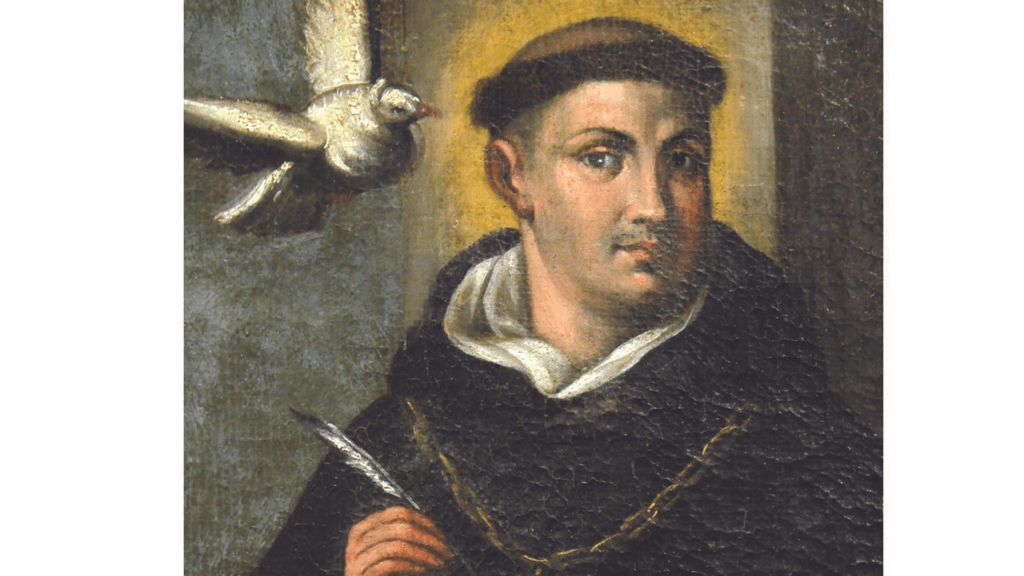
St. Thomas Aquinas is depicted in a painting at the Dominican House of Studies in Washington.
“The light of reason is placed by nature in every man, to guide him in his acts.”
Summa Theologiae, I-II, q.19 a.11
And also:
“All truth, by whomever it is spoken, comes from the Holy Spirit.”
Aquinas saw no contradiction between divine revelation and human reason. Logic is a participation in the Divine Logos.
St. Justin Martyr
“Whatever things were rightly said among all men, are the property of us Christians… For all the writers were able to see realities darkly through the sowing of the implanted word [Logos] that was in them.”
First Apology, 46
Justin Martyr, one of the earliest Christian philosophers, believed that the Logos was implanted in all men, making human reason a reflection of divine truth and natural law.
Pope Benedict XVI
While not canonized yet, Pope Benedict is widely quoted and revered as a saintly theologian. He said:
“Faith in the Logos, in creative Reason, is the basis of the Christian faith.”
Regensburg Address, 2006
This speech powerfully defended the harmony between faith and reason, arguing that the rejection of reason leads to violence and irrationality.
The Logos (Word) is Christ Himself: eternal, rational, the source of all truth that is found in creation. Logic is rooted in Logos, which is Christ, the Word made flesh.
Science Unwraps the Gift of God’s Creation
If Christ is the Logos, the Divine Logic behind all things, then creation is not random. It is intelligent, orderly, and knowable because God made it that way. He speaks creation into being, and what He speaks can be understood by we who are created in His image.
This is why science, when rightly ordered, is not a threat to faith. It is a form of reverent curiosity. It’s the mind of man investigating the works of God, like a child reading the handwriting of their Father.
Here’s how the saints and the Church have spoken of science:
St. Albert the Great (Doctor of the Church and patron of scientists)
“The whole world is theology for us, for the heavens proclaim the glory of God.”
Albert saw the natural world as a living work, not in competition with Scripture, but echoing it. He believed scientific inquiry was a form of praise.
St. Thomas Aquinas
“The study of philosophy [and by extension science] is not undertaken in order to believe, but rather to understand that which we believe.”
Aquinas saw no wall between theology and science, only different lenses for beholding the same reality: God’s creation.
St. John Paul II
“Science can purify religion from error and superstition; religion can purify science from idolatry and false absolutes.”
Letter to the Director of the Vatican Observatory, 1988
A warning and a promise. Faith and reason must work together, each keeping the other healthy and honest.
Pope Benedict XVI
“Science must rediscover its connection to the Logos, to reason, and to the Creator.”
Homily, 2006
He taught that science unmoored from the Logos becomes dangerous, but that true science is a noble and sacred path toward truth.
Catechism of the Catholic Church (no. 159)
“Though faith is above reason, there can never be any real discrepancy between faith and reason. Since the same God who reveals mysteries and infuses faith has bestowed the light of reason, God cannot deny Himself, nor can truth ever contradict truth.”
This is the cornerstone of Catholic intellectual life: truth is never at war with itself. If it’s real science, and real faith, it will harmonize.
In the eyes of the Church’s great saints, science is a sacred curiosity. It is the soul stretching its eyes toward the stars, or into the cell, or into the atom…and quietly asking, “How did You do it, Lord?”
It is the Logos that gives the world its order, and Love that gives it meaning.
Oh Jesus, I surrender myself to you, take care of everything














 gracearmstrong.art