

Mary Magdalene has become one of the most misunderstood figures in all of Christian history, not because of what the Church teaches, but because of what modern fiction, films, and fringe theories have invented.
You’ve probably heard whispers about “lost gospels,” secret teachings, and a supposed romantic relationship between Jesus and Mary Magdalene. Much of this comes from a Gnostic text called The Gospel of Mary, written long after the time of Christ and rejected by the early Church. It doesn’t reflect apostolic Christianity, it reflects Gnosticism, a spiritual counterfeiting movement that’s been twisting the truth since the early centuries.
Let’s separate the truth from the hype.
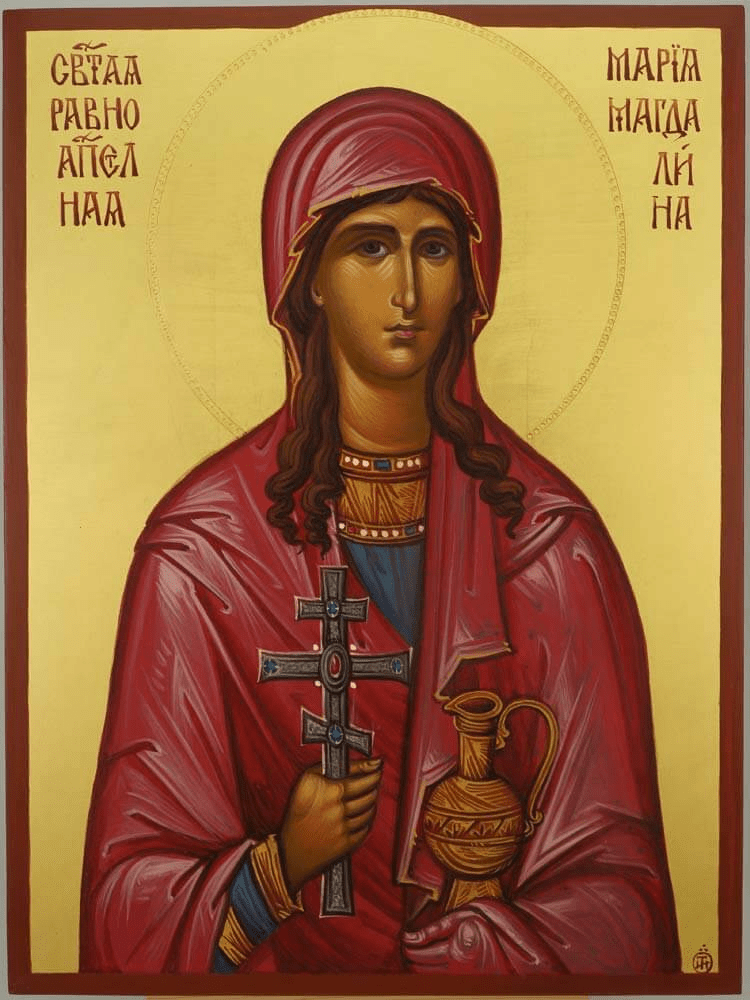
Saint Mary Magdalene
This is the Mary Magdalene the Church has honored for over 2,000 years …a faithful follower of Christ, the “Apostle to the Apostles,” and a model of repentance, humility, and love.
- First to witness the Resurrection
- Delivered from seven demons by Jesus (Luke 8:2)
- Present at the Crucifixion and at the empty tomb
- A repentant sinner and a woman of deep devotion
- Honored as a saint and celebrated on July 22
- Never portrayed romantically in Scripture
- Her life was transformed by grace, not secret knowledge
- Represents the power of mercy and true conversion
Gnostic Mary Magdalene (from the Gospel of Mary & other texts)
This is the reimagined Mary promoted by Gnostic writings and modern revisionists — not based on history, but on late, heretical texts written to push a very different theology.
- Said to have received “hidden” teachings from Jesus
- Depicted as superior in spiritual knowledge to the male apostles
- Clashes with Peter in symbolic power struggles
- Used as a literary tool to elevate Gnostic “gnosis” over apostolic truth
- Often linked to feminist or romantic reinterpretations
- Embraced by New Age and esoteric movements
- Emphasis on spiritual elitism, not repentance
- Contradicts the sacramental, incarnational faith of the Church

So, what do we do with the Gospel of Mary?
We recognize it for what it is: a non-canonical, Gnostic text that offers insight into early heresies, not early Christianity.
It was written well after the apostolic age and rejected by the Church Fathers, not because it was threatening, but because it simply wasn’t true. While it’s useful for studying what the early Church rejected, it’s not Scripture, and it doesn’t tell us who Mary Magdalene really was.
The real Mary Magdalene didn’t need secret knowledge or special status. She had Jesus, and that was enough.
1. Luke 8:2–3
“…Mary, called Magdalene, from whom seven demons had gone out, and Joanna… and Susanna, and many others, who provided for them out of their means.”
Mary as a healed and devoted follower who materially supported Christ’s ministry.
2. John 20:16–18
“Jesus said to her, ‘Mary.’ She turned and said to Him in Aramaic, ‘Rabboni!’ (which means Teacher). Jesus said to her, ‘Do not cling to me… but go to my brothers and say to them…’ Mary Magdalene went and announced to the disciples, ‘I have seen the Lord!’”
She is the first witness of the Resurrection — the “apostle to the Apostles.”
3. Mark 16:9
“Now when Jesus was risen early the first day of the week, He appeared first to Mary Magdalene, out of whom He had cast seven devils.”
Confirms her deep deliverance and Christ’s choice to appear to her first.
St. Gregory the Great
“She longed for Him whom she thought had been taken away, and because she longed, she wept; and as she wept, she bent down… It was only right that she, who had loved so much, should see Him first.”
Homilies on the Gospels
He affirms her deep love and devotion, connecting her to the repentant woman in Luke 7 (a common tradition in the West).
St. Augustine
“She was the first to see the risen Christ, and it was she who announced to the disciples the resurrection of the Lord.”
Sermon 232
Emphasizes her essential witness to the Resurrection.
St. Anselm of Canterbury
“Blessed Mary Magdalene… chosen to be the first witness of the Resurrection, and the apostle to the apostles… May she obtain for us the grace to rise with Christ in newness of life.”
Beautiful invocation of her intercession and example.
 gracearmstrong.art