On Cedar Ridge, the fence lines were long and the mornings came early.
They had built the homestead together; post by post and row by row. They both worked hard to keep it standing, growing, and solvent.
He handled the cattle, the contracts, the heavy posts that needed driving deep into stubborn ground. He thought about expansion. About markets. About what the ranch could become. He did a lot of thinkin.’
She handled the garden, the books, the meals, the mending, the cleaning, and the rhythms that made this land their home. She kept the house steady. She helped with calves when needed. She showed up wherever the work spilled over.
They both worked every day, with rare days off, because a homestead doesn’t run itself.
One morning, pulling on his hat, he said, “I know you’ve got a lot going on, but don’t let the house go.”
She stood still for a moment.
Later that afternoon, watching him sketch plans for a new venture at the kitchen table, she nearly said, “I know you’re dreaming big, but don’t forget to bring in what keeps this place fed.”
She didn’t.
Because she knew something.
It’s easy to protect your own domain. Harder to honor the labor that doesn’t look like yours.
He carried weight she could not carry the same way. She carried weight he barely saw because it ran quietly in the background.
So instead of sharpening the moment, she waited.
That evening she said, evenly, “We both build, grow, and protect this land. We’re guarding the same ground. Let’s not talk as if only one of us is.”
He was quiet.
Out on the ridge, the fences stood straight.
A fence doesn’t shout across the pasture. It simply holds its line.
And in a marriage, sometimes strength looks like restraint; not because you lack words, but because you guard what has been entrusted to you.
Why the Sweet, Playful Spirit of Woman is Love in Its Highest Form
“A joyful heart is the health of the body, but a depressed spirit dries up the bones.” — Proverbs 17:22
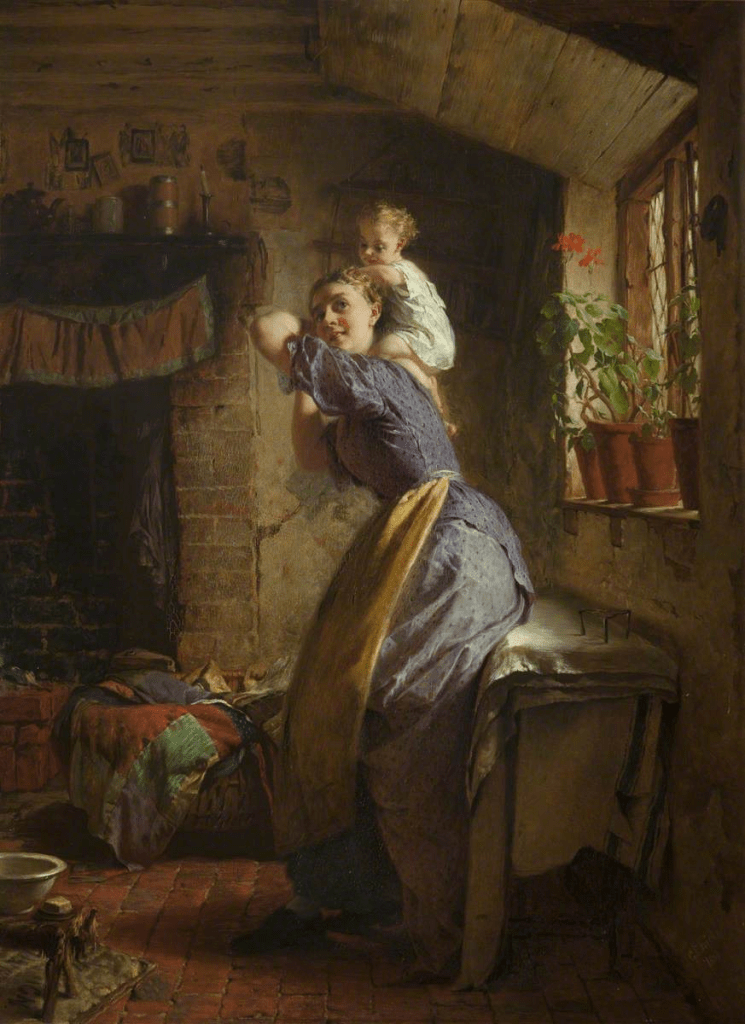
The Happy Mother George Elgar Hicks (1824–1914)
“To be simple and full of laughter is no small virtue; it is the humility of the heart that knows it is loved.” — Grace Armstrong
This reflection is drawn from my upcoming book,The Power of Virtue, a work exploring feminine strength, virtue, and the restoration of womanhood.
The restoration of the feminine soul begins not with anger, but with joy remembered.
There is a sacred kind of silliness that belongs uniquely to woman; the lighthearted, tender playfulness that makes a child laugh and teaches him that the world is good. It is the sweetness that delights in tickling a baby’s toes, singing nonsense songs while folding laundry, or dancing barefoot in the kitchen because the soul is too full of life to stay too serious all the time. This silliness is not immaturity. It is joy made visible; the mark of a woman whose heart is still free enough to love without calculation. Like a child.
God designed women to be near the child, not only in the womb but in spirit too. Her hormonal and nervous systems are exquisitely tuned for relational bonding and emotional reading. Her moods shift easily, her empathy runs deep, and her sensitivity allows her to detect what words cannot say. These are not a flaws but a features. Woman was created to form life at its most impressionable stage. A mother’s face is the first mirror of the world a child sees, and the peace or stress reflected there imprints the child’s soul more deeply than any lesson later taught.
It is no wonder, then, that in the Christian hierarchy of love, Christ leads the husband, the husband leads the wife, and the wife leads the children. The pattern is not one of domination, but honor, respect and protection. The man must shoulder the heavier labors, dangers and physical extremes so that the woman can be free to dwell in that gentler realm where both bodies and souls are formed. Her power is inward, spiritual, delicate yet powerful beyond measure; and therefore indispensable. When a man carries too little and a woman too much, both collapse in mind, body and spirit. She becomes brittle, he becomes aimless, and the home grows cold.
The laughter of a woman is the echo of the Garden; where child like joy was once effortless, but is now endangered. It is the sound of a small heart still innocent enough to trust in Love.
Maternal Affection by Hugues Merle. This painting, to me, captures the heart of finding joy in motherhood.
“Cheerfulness strengthens the heart and makes us persevere in a good life.” — St. Philip Neri
To live under constant stress, competition, or masculine worldly pressure exhausts the feminine design. Women can succeed in those worlds, and many have, even in pre-modernity; but it often costs them their laughter, softness, and feminine joy. It is a kind of soul-crushing triumph. Modernity calls this “empowerment,” but what it often produces are anxious, sarcastic, and joyless women — quick to mock what is innocent and to turn every sweetness into irony. Today’s pop culture humor, soaked in nihilism, celebrates this decay. It is no longer the laughter of delight but the smirk of despair.
This loss of feminine silliness is a cultural tragedy. For when woman loses her ability to be lighthearted, the moral atmosphere of civilization grows heavy. Silliness, rightly ordered, is humility in motion; the ability to laugh at oneself, to find delight in small absurdities, and to put others at ease with her own foibles. It is a fruit of joy, not vanity or frivolity. A mother who can kneel to play, sing, or joke with her children transmits a deep and needed security to their souls; she teaches them that love is not earned but enjoyed, cherished, and shared in self-giving communion.
“Truly I tell you, unless you turn and become like children, you will never enter the kingdom of heaven. Whoever humbles himself like this child is the greatest in the kingdom of heaven.” — Matthew 18:3-4
Psychologically, this maternal playfulness releases oxytocin; the bonding hormone that lowers stress and strengthens emotional connection. It heals the nervous system of both mother and child. In contrast, chronic stress floods the body with cortisol, hardening the heart and darkening the mind. A society of anxious women becomes humorless not by chance but by chemistry. We were never meant to live as machines; our design is relational and rhythmic — to nurture, to rest, to rejoice.
The modern woman does not need more ambition to attain worldly success; she needs permission to be gentle again; with herself and her loved ones. To be silly without shame or guilt for not being “productive” enough. To let her laughter sanctify the home instead of silencing it with her deep sense of unfullfilment. Feminine silliness is the joy of a trusting and faithful soul. It is the playfulness of the heavenly realms breaking into the ordinary. Silliness is a salve for both the learning souls, and the weary ones. Silliness nurtures, heals and connects hearts!
When such laughter returns; the sweet, unselfconscious laughter of women who are not trying to prove themselves by impossible standards; children will again feel seen and safe, husbands will reconnect with their higher purpose, and civilization will once more remember what it means to be connected to the divine order that makes love intelligible and life worth living.
When laughter is restored to woman, order is restored to love. This is where renewal begins; not in protest or pride, but in the quiet strength of joy.
I grew up on stages and in studios, steeped in theater, dance, and music from the time I can remember. It was my daily bread. My formation. Thank you, Mom, for forcing me to do it! From Shakespeare and children’s theater production on the Big Island, to costume sewing and prop design and onstage performance, I have lived and breathed the craft.
I love it so much!
Even after becoming a mother, I stayed in the rhythm of performance, eventually shifting from the stage to the less demanding focus (for a new mom) on the music and local gig world. Songwriting became my great love. I really loved it and was always learning as much as I could – a bit of percussion and hand-drums, guitar, and uke.
My last play was in the The Vagina Monologues in 2012 (not a feminist, just a theater girl who said “why not?”), I gave myself wholly to the role, and it was very challenging and rewarding. That’s the magic of theater: it asks everything, but it gives so much back.
Back to my story. When I was 16, I decided I was going to be a jazz singer, after realizing I wasn’t cut out to be an opera singer (LOL!!!!). This decision was also very bold for a girl still learning where the beat landed. My sense of timing was off, my ear still green. But I had a big heart for singing, and so much love for vintage music from the time I was a toddler. I also had a mentor.
Jim had played with the legends: Nat King Cole, Anita O’Day, Blossom Dearie. He comically named his home, Club Jim, and it was a living archive of jazz history… a sanctuary for any musician who wanted to show up to his weekly jazz jams…that came with an open invite to all his musical friends. I showed up. I stayed. I learned. I had no idea how blessed I was to be there!
He became a very close friend, my mentor, and a formative part of my musical soul.
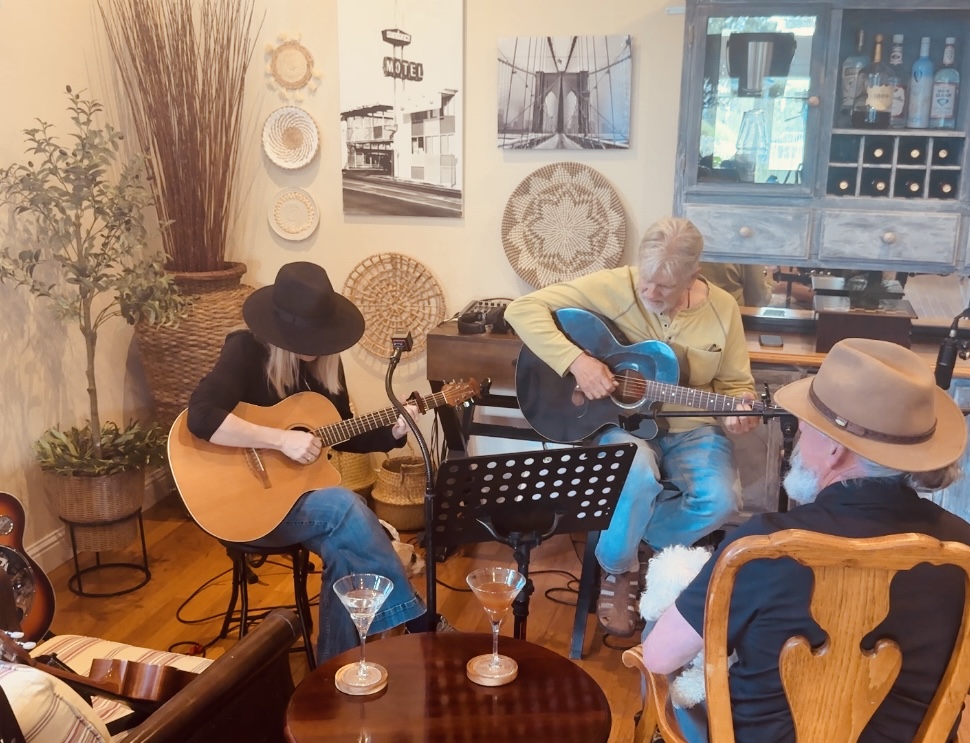
So now, in that same spirit, I’m launching “Club Grace” …a little corner of my home where the all those old romantic songs still live, a makeshift stage is in the making, and I hope many musical moments will be made with my musical friends. Not just vintage jazz. I am all about variety in musical genres!
Club Grace (a work in progress, going to make a better stage):
Every Thursday night, or possibly every Monday, I’ll be hosting a sweet and groovy jam and playing some great music, right from my front room. Just me and friends, old and new, carrying the torch with the same joy that started it all.
For all of us who love the music.
I hope to be sharing these performances on my YouTube channel and here at gracearmstrong.art.
You’re invited to join me , wherever you are.
Stay tuned. Light a candle for the blessing that is music. And welcome to Club Grace.



 gracearmstrong.art